
softGlue
Table of contents
Overview
The synApps softGlue module enables EPICS users and application developers to construct small, simple, digital electronic circuits, and to connect those circuits to field wiring, all by writing to EPICS PVs. Because the circuits and field connections are defined entirely by EPICS PVs, they can be saved and restored with autosave, saved as text files (for example, as BURT snapshot files), emailed from one user to another, etc. softGlue also provides safe (throttled) user control over how hardware interrupts are generated by field I/O signals, and how they are dispatched to cause EPICS processing.
The name softGlue is intended to suggest glue electronics implemented by software, where glue electronics means those little bits of digital circuitry needed to connect two or more larger pieces of digital electronics into a working whole.
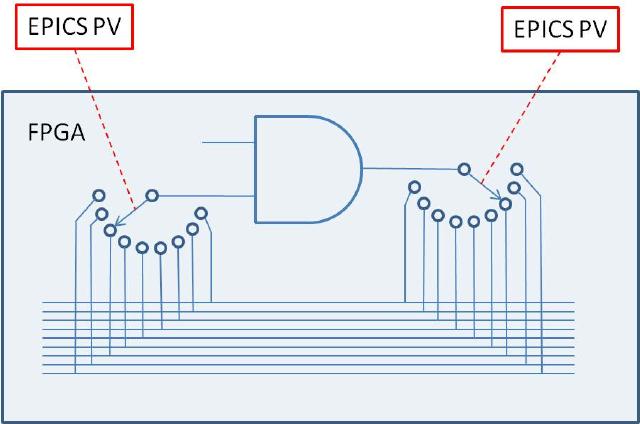
softGlue does this by loading an IndustryPack FPGA-based digital I/O module with a predefined collection of circuit elements (logic gates, counters, flip-flops, etc.), whose inputs and outputs are connected to switches controlled by EPICS PVs. softGlue provides a user interface for controlling those switches, allowing inputs and outputs to be marked with user-specified names, and connecting or driving inputs and outputs according to those names.
Here is the underlying idea, schematically:
Requirements
To use softGlue, you must have the following hardware and software.
Hardware
- An IndustryPack (IP) carrier board supported by the EPICS ipac module.
- An Acromag IP-EP20x FPGA IP module.
softGlue 2.x is intended to be usable with any IP_EP200-series module, but the databases and MEDM displays supplied in this version are for the IP_EP201, and other modules in the series have not yet been tested. The differences between modules are in the numbers of I/O bits and the pinout.
Software
- asyn, version 4.6 or higher.
- ipac, version 2.11 or higher. To use an earlier version, see “Building softGlue” in the Installation page.
- The EPICS extension msi, version 1-5 or higher. This tool is needed to build some softGlue databases.
- MEDM, or CSS-BOY, or caQtDM, or the ability to adapt some other display manager or Channel Access client to implement softGlue’s user interface.
softGlue versions 2.1 and lower also require the EPICS calc module. Some of the databases, displays, and examples presume the availability of other synApps modules, such as calc, busy, and std, but these are not needed for any essential feature of softGlue.
You do not need to be able to program the IP-EP20x module. In the default implementation, the FPGA content is programmed automatically into the module at IOC-boot time, via the IP bus. A text file is included with softGlue for this purpose. softGlue attempts to load the FPGA on every IOC boot, but the load succeeds only on a cold boot. A warm boot leaves previously loaded content in place.
If you have a copy of Altera’s Quartus software, you can load your own custom FPGA content into the module and use softGlue to talk to it. softGlue was designed with this use in mind, though documentation on how it’s done is not yet available.
Capabilities
Here are a few examples of the sorts of things that can be accomplished with softGlue and EPICS:
- With no programming at all, softGlue functions simply as good support for a 48-bit digital I/O module.
- Conditionally send a trigger signal to a detector after every N steps of a stepper motor.
- Conditionally send a trigger signal to a detector after every N(i) steps of a stepper motor, where N(i) is an array of step-interval numbers.
- Gate a detector off during the acceleration and deceleration portions of a stepper motor’s motion.
- Send a trigger to a detector precisely 23 ms after sending a trigger to a shutter.
- Conditionally trigger the execution of an EPICS record on the change of state of an external signal.
- Implement an extraordinarily smart trigger signal for an oscilloscope.
- Implement efficiently a timer usable by EPICS software, with a time resolution that is much better than the system clock’s resolution. (With this, you can for example cause an EPICS database to wait for 0.7 ms.)
Implemented circuit elements
In the standard FPGA content, softGlue provides the following circuit elements:
- Four AND gates
- Four OR gates
- Four noninverting buffers
- Two XOR gates
- Four D flip-flops
- Two 2-input/1-output multiplexers
- Two 1-input/2-output demultiplexers
- Four 32-bit counters
- Four 32-bit preset counters
- Four 32-bit divide-by-N circuits
- 48 field-input bits
- 48 field-output bits
- One 8 MHz clock signal
Earlier versions of softGlue implemented many components with both inverting and noninverting outputs. Beginning with 2.0, signal inversion is accomplished by appending
*to a signal name, and this removes the need to implement inverted outputs. Unfortunately, this means that softGlue PV values saved from an earlier version of softGlue will not restore correctly in softGlue 2.x. The functionality of the circuit will certainly still be achievable, but signal names have changed, and the circuit will have to be re-engineered.
In addition to the above listed components, softGlue 2.x includes shift registers, up/down counters, and quadrature decoders in separate FPGA packages. Currently, only one FPGA-content file can be loaded at a time (the IP-EP20x FPGA does not support loading more than one), but the standard softGlue FPGA content can be combined with any one add-on package. Thus, there is a clear path to standard softGlue plus application-specific FPGA content and support. softGlue databases and display files are engineered to simplify the development of support for add-on packages.
Credits
The essential enabling work underlying softGlue is Eric Norum’s IndustryPack Bridge. David Kline engineered a proof-of-principle implementation, working from another of Eric’s bus-interface solutions, for a non-VME architecture. Marty Smith wrote a driver to talk to custom FPGA content interfaced to Eric’s IndustryPack Bridge. Kurt Goetze and Marty Smith implemented the FPGA content included with softGlue, and Tim Mooney extended Marty’s driver and wrote the EPICS application.